

Full service commercial moving for Bronx offices means a mover manages nearly every physical and logistical task, and the team at 5 Star Movers LLC commercial moving in Bronx, NY provides a useful model of how packing, transport, setup and optional services work in real projects.
Definition of full-service commercial moving
Full service commercial moving is a bundled service where the mover plans, packs, protects, transports and sets up your office contents, instead of just loading pre packed boxes. It combines labor, materials, trucks and coordination into one integrated project.
In a typical Bronx office move, this can include pre move planning calls, on site surveys, labeling systems, packing of workstations, protection of building surfaces, transport between locations, placement of items at the new office and post move adjustments.
The exact package may vary, but reputable movers define what is and is not included in writing. Government and consumer resources such as the FMCSA Protect Your Move program and its moving checklist encourage businesses to request detailed, written descriptions of services before signing a contract.
What is included in full-service moving?
Full service moving includes a coordinated bundle of services that cover packing, loading, transport, unloading and setup, so the mover handles most physical and logistical tasks while your team focuses on running the business during the relocation.
For Bronx offices, this usually starts with a structured pre move plan. Crews arrive with packing materials, labels and floor protection. They pack desks, storage areas and shared spaces, then disassemble modular furniture where needed. Items are wrapped or padded, labeled and loaded using carts and dollies that suit the building layout.
During transport, the mover is responsible for securing loads, complying with New York City commercial vehicle rules and using legal loading zones or docks where available. At the new office, items are unloaded, positioned according to floor plans and reassembled. Basic cleanup of materials and final walkthroughs close the job.
Professional packing and labeling of office contents
Proper packing and labeling are central to full service moving. Crews create a labeling scheme that ties each workstation, office or room to a code that appears on boxes, crates and furniture tags.
Typical office packing tasks include:
- Desk contents, drawers and overhead storage
- Filing cabinets and archive rooms
- Supply rooms and shared storage
- Break rooms and reception areas
- Conference rooms and training rooms
Professional packing focuses on protecting items and reducing confusion at the destination. Files stay in order, fragile items are wrapped, and labels indicate both origin and destination zone so that unloading is efficient. This approach aligns with OSHA and NIOSH guidance on safe handling and stacking of materials in workplaces.
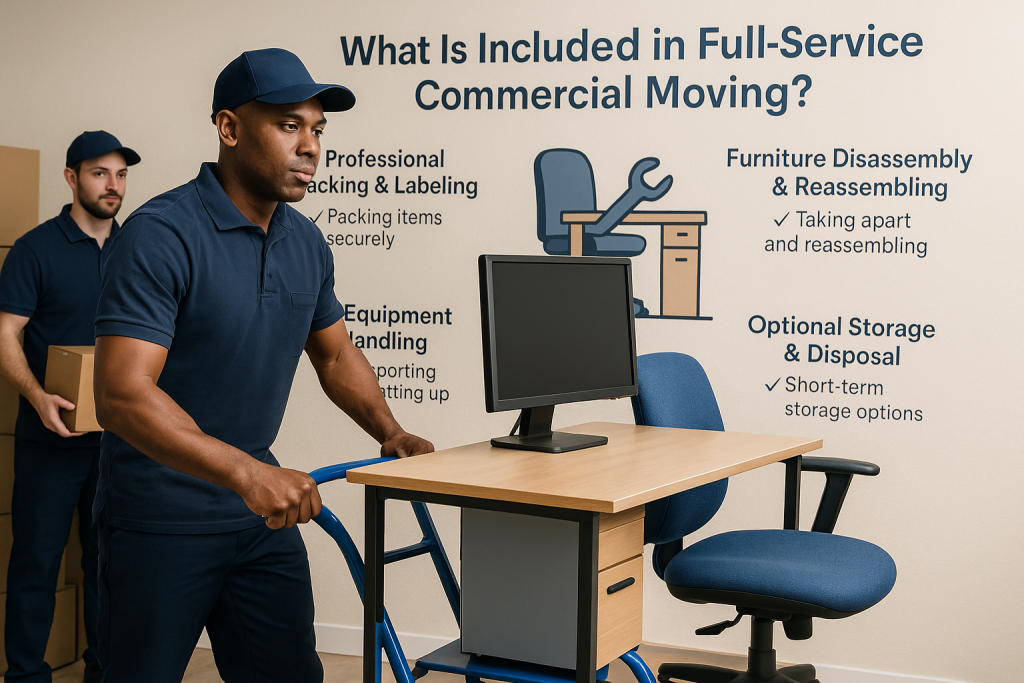
Furniture disassembly, protection and reassembly
Most full service packages include disassembly and reassembly of office furniture that cannot move in one piece. This can cover:
- Workstations and panel systems
- Conference tables and large desks
- Shelving and racking units
- Reception counters and specialty fixtures
Crews remove components, bag hardware and label parts so they can rebuild items correctly at the new office. Furniture surfaces, edges and glass are padded or wrapped to protect against damage during handling and transport.
Full service movers also place floor runners, corner guards and door jamb protectors to shield the building itself. These preventive steps are part of safe material handling practices recommended in occupational safety manuals for moving and storage operations.
Handling IT equipment, servers and sensitive files
IT handling within full service packages often includes systematic packing of monitors, peripherals and basic desktop devices. Crews may use anti static bags, foam inserts and screen protectors.
Sensitive areas such as server rooms and confidential file storage may be managed jointly between the mover and your internal IT or records team. Movers supply the labor and equipment to carry and secure items, while technical staff shut down, disconnect and later restart systems.
Written scope documents should specify who is responsible for:
- Shutting down servers and network devices
- Disconnecting and labeling cables
- Packing and securing backup media
- Transporting and guarding confidential files
Because server and network work can affect regulatory compliance and business continuity, many companies retain specialists for the technical aspects while relying on full service movers for the physical relocation.
Do full-service movers pack and unpack offices?
Yes, full service movers typically pack and unpack office contents, including desks, files, common areas and shared equipment, as long as these tasks are included in the written scope of work and scheduled early enough for crews to prepare materials and labels.
For Bronx companies, packing often begins a day or more before move day, depending on office size. Crews work from detailed inventories and floor plans. They may start with seldom used storage areas, then move to active workspaces closer to the move date so that staff can continue working.
Unpacking services at the destination can include:
- Placing boxes and crates at the correct workstations
- Unpacking files into pre labeled cabinets
- Setting up basic desk layouts such as monitors and accessories
- Removing and recycling packing materials
Businesses can choose full unpacking for critical departments and lighter unpacking for less sensitive areas. The key is to document which groups receive what level of service so costs and expectations match. Consumer advisories from BBB recommend clarifying these details before signing a contract.
Do commercial movers handle furniture assembly and wiring?
In most commercial projects, movers handle furniture disassembly and reassembly, and may assist with basic disconnecting and routing of cables, but they usually do not replace licensed electricians or IT specialists for complex wiring, network equipment or building infrastructure changes.
Furniture services in a full service package often include:
- Disassembling workstation panels and support legs
- Removing table legs, modesty panels and attached power strips
- Reassembling items according to manufacturer instructions
- Adjusting footprints to fit new floor plans
When it comes to wiring, movers may coil and label low voltage cables, route them through grommets and secure them under desks. However, they normally do not modify building wiring, open electrical panels or program network hardware. Safety regulations and electrical codes require qualified technicians for that work.
A clear division of responsibilities between movers, IT providers and building engineers reduces risk. OSHA guidance on safe work practices supports assigning electrical and network tasks only to trained personnel while movers focus on physical handling and placement.
Transportation, unloading and office setup
Transportation is the central link between packing and setup. Full service movers use commercial trucks that meet city and state requirements, and drivers must comply with regulations on commercial parking, loading zones and safe driving inside New York City.
On move day, crews:
- Protect elevator interiors and common areas at both sites
- Load pre packed items in a sequence that matches the plan for unloading
- Secure loads with straps and blocking to prevent shifting
- Travel between locations using safe truck routes
- Unload items directly to their destination rooms or workstations
Initial office setup usually involves placing furniture according to floor plans, aligning workstations into rows, positioning conference tables and ensuring that aisles and exits remain clear. Detailed ergonomic positioning of monitors or chairs is usually handled by internal staff after move completion.
Is storage included with full-service commercial moving?
Storage is sometimes included in full service commercial moving as an optional add on, usually when there is a gap between leaving the old office and occupying the new one, but it is rarely automatic and should be itemized with clear monthly rates.
Short term storage, often called storage in transit, is common when:
- A new lease starts after the old lease ends
- Construction or fit out work at the new site is delayed
- Companies merge locations and need time to consolidate assets
In a full service model, the mover can transport items from the origin site to a warehouse, store them securely and later deliver them to the final office. Contracts should describe warehouse conditions, security measures, access procedures and insurance or valuation options during storage.
Longer term storage needs may require different pricing or even a separate agreement. Businesses should confirm how storage charges interact with moving charges so that budgets account for both transportation days and ongoing storage if necessary.
Optional services: storage, junk removal and decommissioning
Beyond standard storage, full service movers sometimes offer additional services that help businesses close out old locations and streamline new ones. These can include:
- Junk removal for unneeded furniture and equipment
- Recycling and donation coordination
- Removal of old cabling, whiteboards or fixtures specified by lease terms
- Final broom sweep or light cleaning for vacated spaces
These services support lease compliance and reduce the burden on internal facilities teams. They also align with broader sustainability and waste reduction goals when items can be reused or recycled instead of discarded.
Companies should ensure that any removal or decommissioning work is clearly authorized by the landlord, especially if it involves removing built in elements. Written approvals and detailed scopes reduce disputes at the end of a lease.
Are packing materials included in full-service moving?
Packing materials are often partly included in full service moving, especially standard boxes, tape and padding for furniture, but high volumes, specialty crates or reusable plastic crates may be billed separately, so businesses should confirm exactly what is covered in the estimate.
Common inclusions are:
- Cardboard boxes in standard sizes
- Packing paper and bubble wrap
- Tape, labels and marker pens
- Furniture pads, stretch wrap and floor protection
Special materials such as custom crates, server crates, art cartons or reusable plastic crates may carry extra fees. Some movers charge box or crate rental by the week, which can still be cost effective if it speeds packing and unpacking.
Best practice is to request a materials sheet with unit prices and inclusion rules. BBB guidance on choosing full service movers recommends getting all such details in writing so total cost is transparent and you can compare offers fairly.
When full-service commercial moving is worth the investment
Full service commercial moving is most valuable when downtime, staff distraction and risk to equipment cost more than the premium you pay for expanded services.
Situations where full service often makes sense include:
- Offices with limited internal staff to handle packing
- Companies with critical systems that must be moved and restarted quickly
- Multi floor or multi building relocations with tight schedules
- Moves into buildings with restrictive access rules or narrow time windows
By outsourcing packing, labeling and setup, leadership teams can keep employees focused on clients and operations. This can be particularly important in finance, healthcare, logistics and professional services, where missed deadlines or outages carry direct financial penalties.
How to choose a full-service office mover in the Bronx
Selecting a full service mover involves checking both service scope and compliance. Authoritative resources such as FMCSA’s Protect Your Move program, its registered mover database and BBB moving tips outline practical steps for verifying company legitimacy and service quality.
Key checks include:
- Confirming DOT registration and insurance for interstate work where applicable
- Reviewing complaint histories and ratings with independent organizations
- Requesting on site surveys for larger offices
- Obtaining written estimates that describe all included and optional services
- Asking which tasks are handled by in house crews versus subcontractors
Within 5 Star Movers LLC, commercial customers can review the main Bronx services overview and long distance moving information to understand how full service offerings extend beyond local office relocations.
Local familiarity also matters. Experience with Bronx neighborhoods such as Pelham Bay, Morris Park, Pelham Gardens, Allerton, Fordham Manor, Norwood, East Bronx, Williamsbridge, Baychester, Kingsbridge, Castle Hill, Schuylerville, Clason Point, Soundview, Hunts Point, Woodlawn Heights and Wakefield helps movers anticipate loading challenges and building access patterns across the borough.
Frequently Asked Questions
How detailed should my inventory be for a full service office move?
A practical inventory lists the number of workstations, private offices, conference rooms, storage areas and special equipment, along with notes on heavy or sensitive items, so the mover can plan crew size, materials and truck space accurately.
Can full service movers work outside regular business hours?
Many full service movers schedule evening and weekend work to match building rules and minimize disruption, although premium rates may apply, so confirm available windows and pricing when you set your target move date.
How are confidential files handled in a full service move?
Confidential files are usually packed in sealed, labeled containers, kept under controlled custody during transport and delivered directly to designated secure rooms, and some businesses add tamper evident seals or escorts for highly sensitive records.
What responsibilities remain with my internal IT team during a full service move?
Internal IT teams typically retain responsibility for system shutdowns, data backups, hardware labeling, network reconfiguration and post move testing, while movers provide labor and equipment for carrying, loading and positioning devices according to the IT plan.
How far in advance should I confirm floor plans before a full service move?
Most movers prefer finalized floor plans at least three to four weeks before move day so they can plan label schemes, staging areas, truck loading order and crew instructions around the exact layout of the new office.
Can full service movers help with coordinating building rules and certificates of insurance?
Reputable movers routinely prepare certificates of insurance and can explain typical building requirements, but tenants must usually submit forms and elevator requests themselves, so coordination between your office, building management and the mover is essential.
How are damages handled under a full service moving contract?
Damage handling procedures depend on valuation terms in the contract, so review whether coverage is by weight, declared value or another method, keep photos and inventories and follow the mover’s documented claim process if issues arise after delivery.
{
  "@context": "https://schema.org",
  "@type": "FAQPage",
  "mainEntity": [
    {
      "@type": "Question",
      "name": "How detailed should my inventory be for a full service office move?",
      "acceptedAnswer": {
        "@type": "Answer",
        "text": "A practical inventory lists the number of workstations, private offices, conference rooms, storage areas and special equipment, along with notes on heavy or sensitive items, so the mover can plan crew size, materials and truck space accurately."
      }
    },
    {
      "@type": "Question",
      "name": "Can full service movers work outside regular business hours?",
      "acceptedAnswer": {
        "@type": "Answer",
        "text": "Many full service movers schedule evening and weekend work to match building rules and minimize disruption, although premium rates may apply, so confirm available windows and pricing when you set your target move date."
      }
    },
    {
      "@type": "Question",
      "name": "How are confidential files handled in a full service move?",
      "acceptedAnswer": {
        "@type": "Answer",
        "text": "Confidential files are usually packed in sealed, labeled containers, kept under controlled custody during transport and delivered directly to designated secure rooms, and some businesses add tamper evident seals or escorts for highly sensitive records."
      }
    },
    {
      "@type": "Question",
      "name": "What responsibilities remain with my internal IT team during a full service move?",
      "acceptedAnswer": {
        "@type": "Answer",
        "text": "Internal IT teams typically retain responsibility for system shutdowns, data backups, hardware labeling, network reconfiguration and post move testing, while movers provide labor and equipment for carrying, loading and positioning devices according to the IT plan."
      }
    },
    {
      "@type": "Question",
      "name": "How far in advance should I confirm floor plans before a full service move?",
      "acceptedAnswer": {
        "@type": "Answer",
        "text": "Most movers prefer finalized floor plans at least three to four weeks before move day so they can plan label schemes, staging areas, truck loading order and crew instructions around the exact layout of the new office."
      }
    },
    {
      "@type": "Question",
      "name": "Can full service movers help with coordinating building rules and certificates of insurance?",
      "acceptedAnswer": {
        "@type": "Answer",
        "text": "Reputable movers routinely prepare certificates of insurance and can explain typical building requirements, but tenants must usually submit forms and elevator requests themselves, so coordination between your office, building management and the mover is essential."
      }
    },
    {
      "@type": "Question",
      "name": "How are damages handled under a full service moving contract?",
      "acceptedAnswer": {
        "@type": "Answer",
        "text": "Damage handling procedures depend on valuation terms in the contract, so review whether coverage is by weight, declared value or another method, keep photos and inventories and follow the mover’s documented claim process if issues arise after delivery."
      }
    }
  ]
}
Plan a full-service commercial office move in Bronx, NY
When your team is ready to define what should be included in a full service office move, start by reviewing the dedicated Bronx commercial moving service and broader moving services offered by 5 Star Movers LLC so you can match real tasks to your budget and timeline.
Organizations that expect to move staff, equipment or inventory across boroughs or out of state can pair full service office support with long distance moving solutions and, where needed, dedicated storage or specialty handling. For schedules that span multiple buildings or neighborhoods such as Pelham Bay, Morris Park, Castle Hill, Kingsbridge and Soundview, early coordination with the Bronx contact team helps align crews, trucks and building approvals so full service support covers every phase of the relocation.

Dillon Buckley is a distinguished Moving Company Expert, renowned for his extensive knowledge and expertise in the realm of the moving industry. With an exceptional talent for articulating complex moving processes into easily digestible information, he has earned recognition as a go-to authority for individuals seeking guidance on relocation, packing, and everything in between.